Goals
1. Identify the background factors that led to the Russian Revolution.
2. Understand the impact of the end of the monarchy and the rise of communism.
3. Analyze how World War I influenced the Russian Revolution.
Contextualization
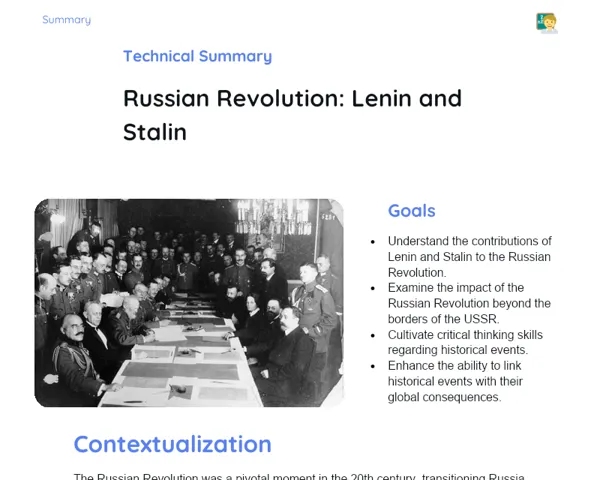
The Russian Revolution of 1917 was one of the most crucial milestones of the 20th century, triggering major political, social, and economic transformations not only in Russia but worldwide. The downfall of the czarist monarchy and the ascent of communism reshaped global relations and had lasting effects on modern politics. A solid grasp of these historical events enables us to better understand today’s social movements and ongoing economic changes. For instance, the revolution led to the formation of the Soviet Union, which was a pivotal player during the Cold War and influenced various independence movements and societal reforms across several nations.
Subject Relevance
To Remember!
Background of the Russian Revolution
The background of the Russian Revolution encompasses a mix of social, economic, and political issues leading to widespread discontent. Russia was primarily an agrarian society with many peasants living in dire conditions. The late onset of industrialization resulted in poor working environments and inadequate wages for urban laborers. Moreover, Russia was ruled by a czarist autocracy that limited political freedoms, and the Russo-Japanese War (1904-1905) alongside World War I intensified the existing economic and social turmoil.
-
Difficult working conditions and meager salaries for city workers.
-
A vast peasant population living in poverty.
-
Czarist autocracy that curtailed political and social liberties.
-
Negative repercussions of wars (Russo-Japanese and World War I) on the economy and society.
End of the Czarist Monarchy
The czarist monarchy fell in February 1917 when Czar Nicholas II stepped down after widespread protests and strikes. This abdication was a direct outcome of public dissatisfaction with living conditions, hunger, and military setbacks in World War I. The monarchy's fall paved the way for the formation of a provisional government, which aimed for reforms but ultimately struggled to tackle the pressing economic and social issues.
-
Abdication of Czar Nicholas II in February 1917.
-
Widespread protests and strikes acted as triggers.
-
Formation of a provisional government that sought to implement reforms.
-
Inability of the provisional government to address economic and social challenges.
Rise of Communism
The rise of communism in Russia was spearheaded by the Bolshevik Party under Vladimir Lenin's leadership. In October 1917, the Bolsheviks took control through a coup, promising the Russian populace 'peace, land, and bread'. They swiftly rolled out a series of radical reforms, including the nationalization of industries and redistribution of land. This shift transformed Russia into a socialist state and ultimately led to the establishment of the Soviet Union in 1922.
-
Leadership of the Bolshevik Party and Vladimir Lenin.
-
The coup in October 1917.
-
The promise of 'peace, land, and bread' to the Russian populace.
-
Implementation of radical reforms, including the nationalization of industries and land redistribution.
-
Founding of the Soviet Union in 1922.
Practical Applications
-
Case study: Examine how Bolshevik propaganda mobilized the masses during the Russian Revolution and relate this to modern mass communication methods.
-
Job market example: Understanding the dynamics of social and political changes can be beneficial for professionals in sectors like political science, history, journalism, and marketing.
-
Practical project: Develop an interactive timeline that showcases the key events of the Russian Revolution, aiding in the visualization of historical sequences and their interconnections.
Key Terms
-
Russian Revolution: A revolutionary movement that toppled the czarist monarchy and ushered in communism in Russia.
-
Czarism: An autocratic governance system headed by the Czar in Russia until 1917.
-
Bolsheviks: The radical faction of the Russian Social Democratic Labour Party led by Lenin, which seized power in the October Revolution of 1917.
-
Communism: A political and economic ideology emphasizing collective ownership of production means and the elimination of social classes.
-
Provisional Government: A temporary government established post-abdication of Czar Nicholas II, which aimed for reforms but was unable to solve Russia's crises.
Questions for Reflections
-
How did the various historical factors contribute to the widespread dissatisfaction that culminated in the Russian Revolution?
-
What similarities can be drawn between the events leading to the Russian Revolution and current situations in different regions of the world?
-
In what ways did the Bolsheviks use propaganda during the Russian Revolution, and how can this be connected to contemporary communication strategies?
Creating an Interactive Timeline of the Russian Revolution
Construct an interactive timeline showcasing the significant events of the Russian Revolution.
Instructions
-
Form groups of 4 to 5 students.
-
Utilize poster boards, markers, rulers, scissors, and printed images depicting the events and key figures of the Russian Revolution.
-
Arrange the events chronologically and engage in discussions about the significance of each event as a group.
-
Incorporate explanatory notes, drawings, and other visuals to enhance the timeline.
-
Present your timeline to the class, elucidating the selected events and their connections.