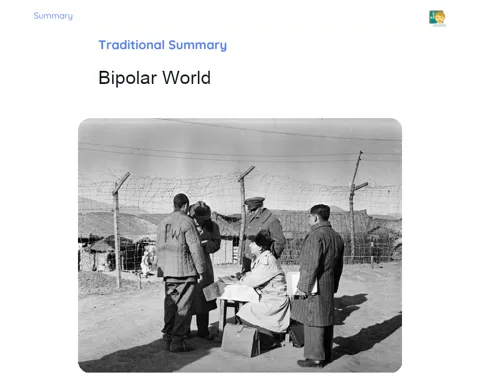
Exploring the Geopolitics of the Cold War
Objectives
1. Understand the concept of the Cold War and the bipolar division of the world.
2. Analyze the geopolitical strategies adopted by the USA and the USSR during the Cold War.
3. Identify the main events and crises that marked the period of the Cold War.
Contextualization
During the Cold War, the world was divided between two superpowers: the United States and the Soviet Union. This period was marked by intense political, economic, and military rivalry that influenced all aspects of global life. The Cold War was not an armed conflict between these nations, but a war of ideologies, influences, and power that left deep marks on global geopolitics. For example, the Space Race, which took mankind to the Moon, was one of the fruits of this technological competition. Understanding the Cold War helps us comprehend the technological development and political alliances that still influence the world today.
Relevance of the Theme
Understanding the geopolitics of the Cold War is essential for careers in international relations, politics, defense, and even in multinational companies that need to understand the historical and cultural legacies in their global operations. This knowledge allows us to interpret current political dynamics and foresee possible future developments, becoming a valuable tool for strategic decision-making.
Concept of the Cold War
The Cold War was a period of political, economic, and military tension between the United States and the Soviet Union that lasted from the end of World War II until the early 1990s. Although there was never a direct confrontation between the two superpowers, rivalry permeated various areas, including the arms race, the space race, and influences in third countries.
-
It was an ideological conflict between capitalism (USA) and communism (USSR).
-
It lasted approximately from 1947 to 1991.
-
There was no direct armed confrontation between the USA and the USSR, but many indirect conflicts.
Bipolar Division of the World
During the Cold War, the world was divided into two blocs influenced by the superpowers: the Western bloc, led by the United States and its NATO allies, and the Eastern bloc, led by the Soviet Union and its Warsaw Pact allies. This geopolitical division affected the politics, economy, and international relations of many countries around the world.
-
Western Bloc: Influenced by the USA and based on market economies and liberal democracies.
-
Eastern Bloc: Influenced by the USSR and based on planned economies and communist regimes.
-
Non-Aligned Countries: Nations that chose not to ally with either bloc, forming the Non-Aligned Movement.
Space Race
The space race was a competition between the USA and the USSR to demonstrate the technological and scientific superiority of their respective systems. It began with the launch of the Soviet satellite Sputnik in 1957 and culminated with the arrival of man on the Moon by the United States in 1969. This period was marked by significant advances in space exploration and technology.
-
Sputnik (1957): First artificial satellite launched by the USSR.
-
Apollo 11 (1969): First manned mission to land on the Moon by the USA.
-
Impact: Advances in satellite technology, communication, and space exploration.
Practical Applications
- Case studies in international relations on the influence of the Cold War on contemporary foreign policy.
- Analysis of technological advances resulting from the Space Race, such as communication and navigation satellites.
- Discussion about the formation of modern military and economic alliances, such as NATO and the European Union, in response to the dynamics of the Cold War.
Key Terms
-
Cold War: Period of tension and rivalry between the USA and USSR without direct armed confrontation.
-
Bipolar Division: Geopolitical division of the world between two blocs influenced by the USA and USSR.
-
Space Race: Competition between the USA and USSR to demonstrate technological superiority in space exploration.
Questions
-
How did the Cold War influence the formation of the foreign policies of the USA and the USSR?
-
In what ways do the technological advances of the Space Race impact our lives today?
-
What lessons can humanity learn by studying the Cold War and its consequences on global geopolitics?
Conclusion
To Reflect
By reviewing the Cold War period, we realize how the bipolar division of the world influenced not only politics but also the economy, science, and global culture. The rivalry between the USA and the USSR drove significant technological advances and shaped alliances that still resonate today. Reflecting on this period helps us better understand current geopolitical dynamics and the importance of diplomacy and international cooperation to avoid global conflicts.
Mini Challenge - Simulated Debate: Cold War Conflicts
In this activity, you will participate in a simulated debate representing one of the countries influenced by the Cold War. Your goal is to defend the actions and policies of your country during this period, gaining a better understanding of the different geopolitical perspectives.
- Divide into groups and choose a country to represent (USA, USSR, Cuba, Vietnam, etc.).
- Research your country's geopolitical position and actions during the Cold War.
- Prepare a 3-5 minute presentation defending your country's actions.
- Participate in the debate, listening to other presentations and asking questions to opposing groups.
- At the end, reflect on how the different perspectives helped understand the complexity of the Cold War.