Lesson Plan: Types of Cells and Their Structures (11th Grade Biology)
Objectives:
- Distinguish between prokaryotic and eukaryotic cells.
- Identify and describe the structure and function of key organelles within eukaryotic cells.
- Compare and contrast plant and animal cells.
- Explain the importance of cell structure to cell function.
- Understand how the structure of different cells helps them perform specific functions.
Materials:
- Computer/Tablets with internet access
- Projector
- Whiteboard or Chart Paper
- Markers/Pens
- Prepared Slides or Digital Images of Cells
- Online simulation of cell structures
Lesson Duration: 50 minutes
Procedure:
-
Introduction (5 minutes)
- Start by asking students what they already know about cells.
- Briefly review the cell theory.
- Explain that this lesson will focus on the different types of cells and their structures.
-
Prokaryotic vs. Eukaryotic Cells (15 minutes)
- Explain the primary differences between prokaryotic and eukaryotic cells.
- Prokaryotic Cells:
- These are simple cells that do not have a nucleus or other membrane-bound organelles.
- DNA is located in the cytoplasm.
- Typically smaller than eukaryotic cells.
- Examples: Bacteria and Archaea.

- Eukaryotic Cells:
- More complex cells with a nucleus and other membrane-bound organelles.
- DNA is enclosed within the nucleus.
- Typically larger than prokaryotic cells.
- Examples: Plant cells, animal cells, fungi, and protists.

- Use visual aids (slides, images, or videos) to illustrate the differences.
- Engage students by asking them to identify examples of organisms with prokaryotic and eukaryotic cells.
-
Eukaryotic Cell Structures (20 minutes)
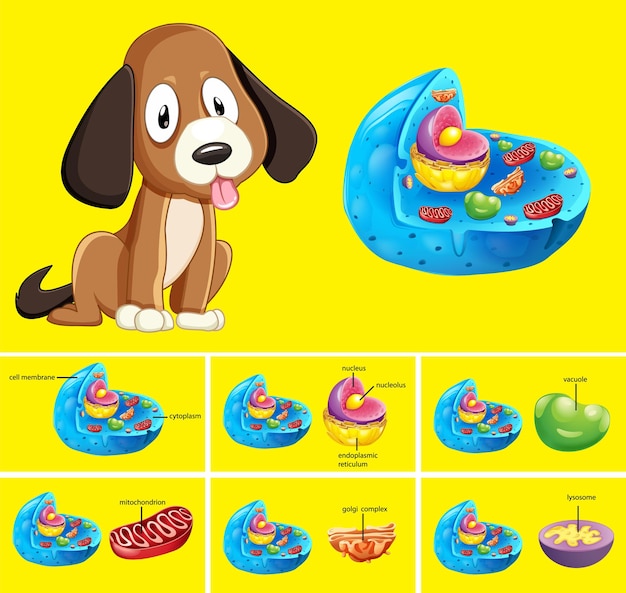
- Focus on the structures within eukaryotic cells, including:
- Nucleus: The control center of the cell, containing DNA.
- Mitochondria: The "powerhouse" of the cell, responsible for energy production (ATP).
- Endoplasmic Reticulum (ER): Involved in protein and lipid synthesis.
- Golgi Apparatus: Processes and packages proteins and lipids.
- Lysosomes: Contain enzymes for breaking down cellular waste.
- Ribosomes: Responsible for protein synthesis.
- Use diagrams or models to show the structure of each organelle.
- Explain the function of each organelle in detail.
- Discuss how these organelles work together to carry out cell functions.
- Use an online simulation or interactive tool where students can explore the different parts of a cell.
- Focus on the structures within eukaryotic cells, including:
-
Plant vs. Animal Cells (5 minutes)
- Highlight the differences between plant and animal cells.
- Plant Cells:
- Cell wall: Provides support and structure.
- Chloroplasts: Site of photosynthesis.
- Large central vacuole: Stores water and other substances.

- Animal Cells:
- Lack cell walls and chloroplasts.
- Smaller vacuoles.
- Discuss the functions that these unique structures allow plant cells to perform.
-
Conclusion (5 minutes)
- Recap the main points of the lesson.
- Ask students to summarize the differences between prokaryotic and eukaryotic cells, and between plant and animal cells.
- Discuss the importance of understanding cell structure in the context of biology and medicine.
Activity Ideas:
- Cell Model Building: Have students create 3D models of cells using various materials (clay, edible items, etc.).
- Cell Analogy: Ask students to create analogies comparing cell organelles to parts of a city or a factory.
- Online Quiz: Use an online quiz platform to assess students' understanding of cell structures and functions.
Assessment:
- Observe student participation in discussions.
- Review student responses to questions during the lesson.
- Evaluate the accuracy and completeness of cell models or analogies.
- Assess performance on the online quiz.
Differentiation:
- For struggling learners: Provide simplified diagrams and models, and focus on the key organelles and their functions.
- For advanced learners: Encourage them to research specific cell types (e.g., nerve cells, muscle cells) and explain how their structure relates to their function.